

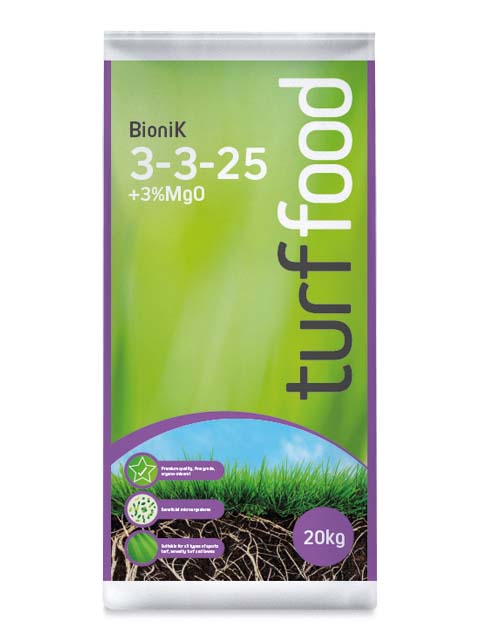


Turf Food Organo-mineral Fertiliser for stronger, steadier turf growth
Turf Food Organo-mineral Fertiliser plays an important role in modern grounds management because it feeds the plant and supports the soil at the same time. On football and rugby pitches, cricket outfields, golf surfaces, lawns and wider amenity turf, that matters. You are not only chasing colour for the weekend; you are trying to build recovery, root strength and a sward that can handle wear.
Unlike a straight conventional feed that can act very quickly, the fertiliser works in a more gradual way. Nutrients are released as soil biology gets to work on the organic matter, so temperature, moisture and microbial activity all influence performance. That slower pattern is often exactly what a busy groundsperson wants: more even growth, less flush, better nutrient efficiency and a lower risk of soft, weak leaf when timings are right.
That is why Organo-mineral Fertiliser sits naturally within both Fertiliser and the wider Plant & Soil Health conversation. It suits surfaces where presentation quality matters, but where long-term grass health, soil nutrient balance and wear tolerance matter even more. A good organic turf fertiliser can help keep growth moving without forcing it; it can also support recovery after play, mowing stress, scarification and seasonal renovation work.
Why organic fertiliser matters in sports turf
In practical terms, organic turf food is about more than nitrogen. Yes, nitrogen drives leaf growth and colour, but a well-chosen organic lawn fertiliser or organic sports turf fertiliser may also contribute phosphate, potassium and trace nutrition, depending on the formulation. The organic fraction can support soil structure, moisture retention and microbial activity; all three are valuable when you are trying to keep a surface active through traffic, weather swings and fixture pressure.
For sports turf managers, the main benefit is often control. A slow-release organic fertiliser tends to produce a steadier response than a fast, highly soluble feed. That can help on pitches where you want consistent mowing yields and stronger recovery without excessive top growth. It is also useful when you are trying to maintain density in perennial ryegrass swards, encourage rooting and avoid the stop-start growth pattern that can affect presentation and play.
Organic fertiliser for grass is also helpful where the soil needs bringing back into better balance. On tired or sandy profiles, a natural fertiliser for turf can form part of a wider programme aimed at improving resilience rather than just chasing short-term colour. On heavier native soils, it can still be effective; you simply need to respect soil temperature, aeration and moisture so that nutrient release matches plant demand. Where moisture movement is uneven, support products from Wetting Agents can help the profile work more consistently.
How Turf Food Fertiliser works in a maintenance programme
A professional programme rarely relies on one product type all year. Turf Food Organo-mineral Fertiliser is usually most effective when it is matched to the surface, the season and the maintenance objective. Early in the growing season, organic-based turf nutrition can help wake the plant up steadily as soil temperatures rise. Through the main season, it can support recovery and sward density without creating too much soft growth. Around renovation, it often sits well alongside Grass Seed because the feed pattern is more measured and helps young plants establish without racing away.
This is where a bit of real-world planning makes a difference. If you apply an organic turf fertiliser to a cold, compacted pitch in poor biological condition, you may not see much response straight away. That is not always a product problem; it is often a timing problem. Organic nutrition depends on soil life, oxygen and moisture. On busy winter pitches, we would usually look at aeration, moisture management and root activity before expecting a strong release pattern. On a well-prepared surface, though, organic turf food can be a very dependable part of the programme.
Testing helps too. Before changing your feeding plan or trying to correct weak growth, low vigour or poor colour, it is sensible to check the profile properly with Soil Testing. That gives you a clearer picture of pH, nutrient reserves and the wider condition of the soil. It also helps you decide whether you need a gentle organic feed, a higher potassium analysis for stress periods, or a different balance of nutrition altogether.
Choosing the right organic turf fertiliser
Not all organic feeds behave in the same way. Some are pelletised organic fertilisers designed for steady nutrient release and easy spreading. Others are organic-based granules that blend natural raw materials with mineral nutrition for a more predictable response. You may also see differences in NPK ratio, granule size, analysis, release pattern and the amount of organic matter included. Those details matter because they affect spread quality, speed of response and how the product fits around mowing and play.
If you are managing a football or rugby pitch, think about recovery speed, fixture gaps and how much top growth you can carry. If you are working on a golf surface or cricket outfield, presentation and clipping yield may be higher priorities. For lawns and managed amenity turf, a slow, even response often makes life easier because colour and density improve without creating an unmanageable surge of growth. In every case, match the product to the surface and the workload.
It is also worth thinking about what sits around the feed in the broader programme. Liquids and biological inputs from Seaweed & Biostimulants can help during stress periods or renovation windows, while profile materials from Loam & Dressing may be part of the same job where seedbed refinement, surface levels or establishment quality need attention. That joined-up approach is usually where organic fertiliser delivers best value.
Seasonal use of organic turf food
Spring is a key window for Turf Food Organo-mineral Fertiliser because soil biology is starting to move and the plant is ready to respond. Late spring and summer are often ideal for sustained growth, colour and recovery, especially where you want a slower, more controlled feed pattern. In autumn, organic fertiliser can still be useful where soil temperatures remain active and you are supporting post-renovation establishment or general recovery. Winter use is more limited on cold soils because nutrient release slows right down; at that point, expectations need to stay realistic.
That seasonality is important. Organic fertiliser for turf is not usually about instant effect in cold conditions. It is about building stronger surfaces over time: better rooting, more consistent growth, improved grass health and a profile that works with you rather than against you. Used well, Turf Food Fertiliser helps connect plant performance with soil function, which is exactly what most sports turf programmes need.
Pitchcare is trusted by turf professionals because the aim is practical performance, not hype. If you want a more measured feeding strategy, improved resilience and a healthier surface through the season, Turf Food Organo-mineral Fertiliser is a smart option for sports turf, amenity grass and serious lawn care alike. It also makes sense as part of a broader buying route through Fertiliser, Plant & Soil Health, Wetting Agents and Grass Seed, so you can build a complete programme around the surface rather than treat nutrition in isolation.


Recently viewed